
Everyone Who Committed Crimes Against Participants in Peaceful Protests Must Be Brought Before Justice
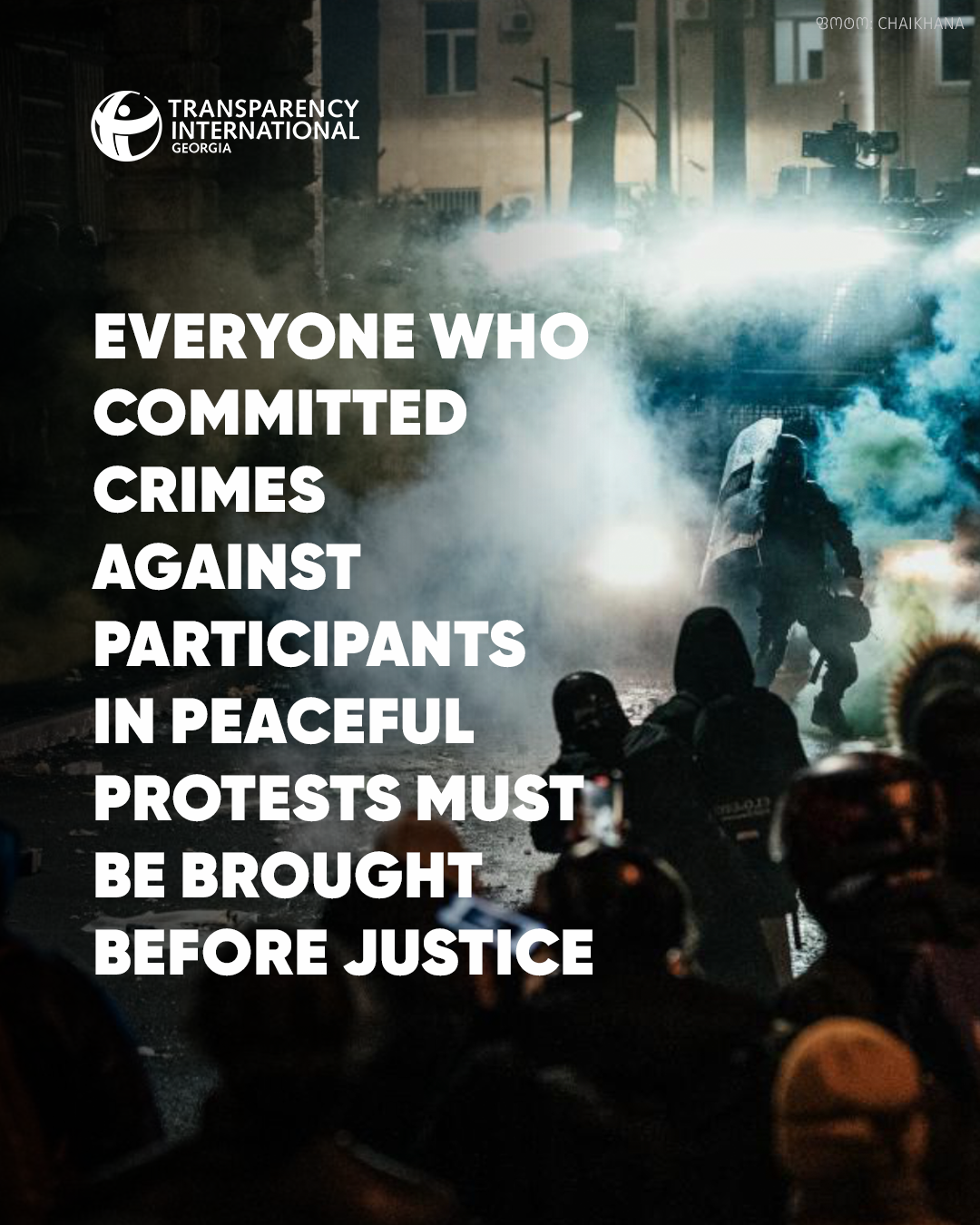
On 7 May 2026, during a briefing, the Prosecutor General of Georgia stated that, in connection with acts of violence committed during the 2024 protests in Tbilisi against Zviad Maisashvili, Levan Khabeishvili, and Guram Rogava, three former and one current special forces officers, as well as one current employee of the Protection Police Department of the Ministry of Internal Affairs, had been identified and arrested.
According to the Prosecutor General, all five detainees will be charged under subparagraph “b” of Article 333(3) of the Criminal Code of Georgia, which establishes criminal liability for “exceeding official authority by an official or a person equated thereto,” committed “through violence or the use of a weapon,” and which “resulted in a substantial violation of the rights of a natural or legal person or of the lawful interests of society or the State.” The offence is punishable by imprisonment from five to eight years.
In relation to the episode involving Guram Rogava, the arrested person will additionally be charged under Article 154(2) of the Criminal Code for unlawfully interfering with a journalist’s professional activities, committed “through threats of violence or abuse of official position.” This offence is punishable by a fine or imprisonment for up to two years.
We believe that the decision of the Prosecutor General’s Office, after a lapse of one and a half to two years from the commission of the criminal acts, to charge only five violent police officers falls far short of reflecting the scale and brutality of the crimes committed by the State against peaceful protesters and journalists throughout 2024, as well as the criminal objective which these acts served. The statement of the Prosecutor’s Office reflects the clear intention and established strategy of both the Prosecutor’s Office and the political leadership of Georgian Dream to avoid an adequate legal assessment of the crimes, a full investigation, and the bringing before justice of all participants in the crimes — whether perpetrators, organisers, instigators, or accomplices.
We would like to highlight several key aspects on which this assessment is based:
- Only Five Participants in the Mass Violence Have Been Charged
Numerous reports and publications by Georgian and international non-governmental organisations, the report of the Public Defender of Georgia, and most recently the report published by the expert of the Moscow Mechanism, all unanimously indicate that the violence committed by various police units, especially masked and helmeted members of the Special Tasks Department, against peaceful demonstrators and journalists during both the spring protests of 2024 and the protests in November of the same year, was not limited to isolated incidents. Rather, it was widespread, systematic, and systemic in nature. The brutal dispersal of demonstrators and reprisals against them were carried out before thousands of peaceful participants of the protests, often directly in front of television cameras. Hundreds, and possibly thousands, of police officers took part in these actions. Hundreds of protesters and journalists became victims of violence, being brutally beaten in groups, including through the use of hands, feet, batons, and other technical means. More than one hundred persons were taken to hospital due to the injuries inflicted upon them.
Such large-scale crimes could not have been committed by only five individuals. Furthermore, according to statements by Guram Rogava and his colleague, journalist Eliso Jariashvili, the five accused do not include the individual who, according to their sources, attacked Guram Rogava and caused him serious injuries to the head and neck.
All of this indicates that the Prosecutor’s Office continues to remain inactive and, by doing so, is shielding hundreds and possibly thousands of other employees of the Ministry of Internal Affairs who participated in the hundreds of criminal acts committed throughout 2024 as perpetrators, organisers, instigators, or accomplices.
- The Legal Classification of the Crimes Clearly Does Not Correspond to the Nature, Scale, Method, and Other Characteristics of the Acts Committed
The charges brought against the five individuals fall under the chapter of the Criminal Code dealing with “official misconduct” (Chapter XXXIX). As noted above, one of them has additionally been charged with unlawfully interfering with a journalist’s professional activities. Thus, from the perspective of the Prosecutor General and the Prosecutor’s Office as a whole, striking a person on the head with an object, repeatedly kicking a fallen person in the face with full force, and engaging in other violent acts endangering life constituted nothing more than offences committed by an official in the course of official duties, whether in an office or elsewhere.
In reality, it is obvious to any reasonable person that such violent acts constitute, first and foremost, crimes against health (Chapter XX). In particular, in the cases of Zviad Maisashvili, Levan Khabeishvili, Guram Rogava, and many others, the constituent elements of intentional grievous bodily harm committed under aggravating circumstances are clearly present, as provided for in subparagraphs “th” (hooligan motive), “l” (committed by a group), “m” (against two or more persons), “n” (with particular cruelty), and/or “o” (for gain or by contract) of Article 117(3) of the Criminal Code. Any such offence is punishable by imprisonment for a term of nine to thirteen years.
Moreover, as noted by the expert of the Moscow Mechanism and as widely explained in other local and international sources, these acts also bear the characteristics of torture committed under aggravating circumstances — by an official or a person equated thereto (Article 144¹(2)(a) of the Criminal Code), through abuse of official position (subparagraph “b”), repeatedly (subparagraph “g”), against two or more persons (subparagraph “d”), by a group (subparagraph “e”), through discrimination violating equality on the grounds of political or other opinions (subparagraph “v”), by contract (subparagraph “th”), and/or for gain (subparagraph “l”). Such offences are punishable by imprisonment for a term of nine to fifteen years.
It is entirely clear that the Prosecutor’s Office is deliberately applying an incorrect legal qualification to the crimes committed in order to ensure that even the few individuals who were “identified” receive much more lenient punishment than warranted by the gravity of their actions.
- The Charges Were Brought One and a Half to Two Years After the Criminal Acts Were Committed
It is noteworthy that the Prosecutor’s Office brought charges against the five individuals only now, despite the fact that one and a half years, and in one case even two years, have passed since the commission of the crimes. The Prosecutor’s Office, like other law enforcement agencies and the political leadership of Georgian Dream, consistently attributes this delay to the alleged impossibility of identifying the perpetrators.
However, it is obvious to everyone that the concealment of identity by representatives of the so-called law enforcement structures, as well as the absence of any external identifying marks on their clothing or helmets, was part of a pre-arranged plan intended to allow perpetrators, while remaining “incognito,” to act more boldly and freely, without fear of liability, while carrying out punitive operations against peaceful protesters and journalists.
Accordingly, the “difficulty” or “impossibility” of identification itself forms part of the responsibility of those who decided upon, planned, and issued orders for these brutal dispersals.
The identities of these persons are known and they have been identified. They include the then Minister of Internal Affairs, his deputies, and heads of ministry departments, none of whom have faced any form of accountability. On the contrary, upon the nomination of the Prime Minister and Speaker of Parliament of Georgian Dream, they were even awarded the Order of Honour by the President associated with Georgian Dream.
However, responsibility cannot end with the leadership of the Ministry of Internal Affairs alone. In a captured state, where the principal factor in appointment to and retention of office within the vertical of power is the unconditional execution of the instructions of superiors — whether lawful or unlawful, including criminal orders — it would be naïve to think that the leadership of the Ministry of Internal Affairs made decisions concerning the dispersals independently and on its own initiative, without instructions from the political leadership of Georgian Dream, including Bidzina Ivanishvili. The leadership of the Ministry would never have dared suppress civil protest through such brutal methods had it not possessed firm guarantees of impunity from Bidzina Ivanishvili and his entourage. Likewise, ordinary special forces officers would never have openly and publicly acted as executors of criminal orders without such guarantees.
These guarantees are reflected precisely in the statements of the so-called Prime Minister claiming that the management of protests in Georgia is conducted according to “higher standards” than in the United States and Europe. The same guarantees are reflected in the systematic denial, until very recently, by leaders of Georgian Dream that any “misconduct,” let alone crimes, had ever been committed against protesters and journalists. Further evidence of such guarantees lies in the constant expressions of gratitude toward the Minister of Internal Affairs and other officials, as well as in their decoration with the Order of Honour. Finally, the same is confirmed by the public statements of the former head of the Special Tasks Department, Kharazishvili, who declared that none of his employees would be punished.
Nevertheless, the regime of Georgian Dream was ultimately forced to break these guarantees in relation to five employees of the Ministry of Internal Affairs. This is the result of the ongoing protests in Georgia, the efforts of the Georgian critical media, civil society, and the opposition political spectrum, as well as the unprecedented support shown to them by the international democratic community, which was ultimately fully reflected in the conclusions of the expert of the Moscow Mechanism.
Viewed in this context, the forced step taken by Georgian Dream to acknowledge that even five police officers committed crimes, even if only against three participants in the protests, is, on the one hand, a farce and a caricature of justice. On the other hand, however, it undoubtedly represents a small yet important success for Georgia’s democratic society and a guarantee that, in due course, the criminal acts committed by the regime of Georgian Dream against its own people and against Georgia’s European future will be fully and thoroughly investigated, and that all perpetrators, organisers, instigators, and accomplices involved in these systemic crimes will be brought before justice.
