
Transparency International Georgia has evaluated how the Supreme Council of the Autonomous Republic of Adjara performed its oversight role in 2021-2022 – noteworthy that the Council did not use four out of nine oversight mechanisms.
The report covers the performance of the Supreme Council of the Fifth Convocation in the period between the validation of the 2020 election results and July 13, 2022. The aim of the report is to analyze the mechanisms of oversight over the Government of Adjara. These mechanisms are defined by the Rules of Procedure of the Supreme Council of Adjara.
TI Georgia’s report reveals that the Supreme Council of Adjara:
Overview of the legal framework
According to the Constitution of the Autonomous Republic of Adjara and the Constitutional Law of Georgia on the Autonomous Republic of Adjara, the Supreme Council of Adjara, along with the legislative activities, is tasked with overseeing the performance of the Government of Adjara. Chapter 14 [2] of the Rules of Procedure of the Supreme Council lists the mechanisms which can be used to control the Government of Adjara:
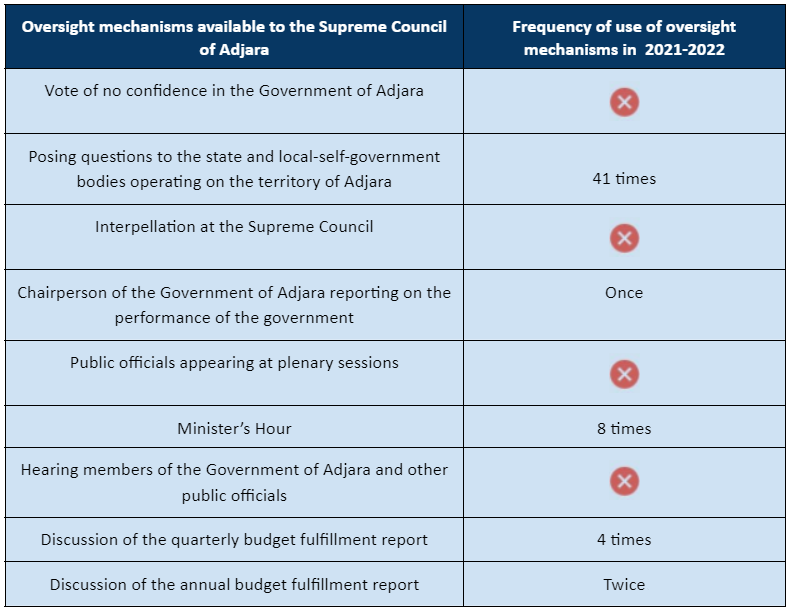
The research revealed that the Supreme Council of Adjara did not use all mechanisms envisaged by the law and was unable to exercise full-fledged oversight over the Government of Adjara. This influenced the work of both the Council and the Government, namely:
Approval of the Government of the Autonomous Republic of Adjara
The Supreme Council of the 2020 convocation approved the Government of Adjara on December 25. 15 members of the Supreme Council were registered: 14 members voted in favor of the approval of the Government; 1 member voted against. The National Movement lawmakers of the Supreme Council did not participate in the voting due to denouncing the results of elections and boycotting the activities of the Supreme Council.
Vote of no confidence in the government
The issue of the vote of no confidence in the government can be initiated by at least one third of the total number of the Supreme Council members. The Supreme Council of the current convocation never raised the issue of the vote of no confidence.
Exercising the right to pose a question
Only 5 members [3] of the current Supreme Council posed [4] questions to the state and local self-government bodies operating on the territory of Adjara: Davit Gabaidze, Chairperson of the Supreme Council (Georgian Dream) posed 16 questions; Vladimer Mgaloblishvili, another member of Georgian Dream – 4 questions; the National Movement lawmakers posed 21 questions, namely: Gia Abuladze – 11 questions, Elguja Bagrationi – 9 questions and Giorgi Kirtadze – 1 question.
A faction or a group of at least three members of the Supreme Council is authorized to use the mechanism of interpellation and pose [5] a question to a body accountable to the Supreme Council, the Government, Government members, who are obliged to answer the questions at a plenary session. None of the Council members used the mechanism of interpellation in the Supreme Council of the Fifth Convocation.
Government performance report delivered by the Chairperson of the Government of Adjara
Tornike Rizhvadze, chairperson of the Government of Adjara, presented a performance [6] report to the Supreme Council of Adjara on June 7, 2022.
The session was marred by sharp political polarization and mutual accusations. The Chairperson of the Government used offensive and irrelevant language. The session prompted the public to assume [7] that not only the Supreme Council of Adjara fails to exercise effective oversight over the Government, but it cannot ensure political debates in the representative body of the region.
The chairperson of the session did not use the mechanisms envisaged by the Rules of Procedure to normalize the process for the Chairperson of the Government to stop using irrelevant language, and instead to discuss the problems related to the delays in the implementation of large-scale projects, the reasons of underspending budgetary funds, as well as social, economic and education problems and their solutions.
Appearance of public officials at plenary sessions
No public officials were summoned for hearing at the plenary sessions of the Supreme Council of the Fifth Convocation.
Minister’s Hour
Minister’s Hour envisaged by the Rules of Procedure was held 8 times in the Supreme Council in 2021-2022. The Minister’s Hour entails individual members of the Government presenting performance reports of corresponding ministries at the Supreme Council plenary session. Factions and committees did not send the list of agenda issues to the ministers in advance.
Discussion of the quarterly budget fulfilment reports
Minister of Finance and Economy of Adjara, Jaba Putkaradze presented an overview of budget fulfillment reports for the first, second and third quarters of 2021, as well as the first quarter of 2022.
Discussion of the annual budget fulfilment report
On 31 March 2021, the Government of Adjara presented the annual report on the fulfilment of the 2020 budget to the Supreme Council. Later, the State Audit Office presented a corresponding review of this report.
The Audit Office noted in its review that the issues related to addressing the problems identified in previous audits, as well as to effective use of reserves remained a problem; the audit identified shortcomings in the enterprises owned by the Autonomous Republic of Adjara, namely, only 2 out of 37 such enterprises paid dividends in 2020. Significant shortcomings were also revealed in the management of the enterprises owned by the Autonomous Republic.
The Audit Office also stated that in 2020, the Government of Adjara failed to use hundreds of thousands of Lari under the programs on road infrastructure development, rehabilitation of general education schools and provision of residential houses to the families affected by natural calamities. The Government cited the difficulties caused by the COVID-19 pandemic as one of the reasons behind its failure to use the funds. However, the Audit Office concluded that in some cases, the failure to use the funds was caused by the delays in preparation of tender documents and generally, in tender procedures.
In general, the document focuses on the need to conduct feasibility studies of budget programs, to measure their effectiveness as well as to plan and implement the next year budget based on the identified conditions.
The Audit Office also presented its review on the annual budget fulfillment to the Supreme Council in 2022. Earlier, the Government of Adjara presented the 2021 budget fulfillment report to the legislature.
In its 2021 budget fulfillment review, the Audit Office points to the failure by the municipalities of the Autonomous Republic of Adjara to use the funds transferred to them under the Government’s capital and special financial assistance – in 2021, the Government of Adjara failed to spend up to GEL 35 million allocated to the municipalities.
Despite the significance of identified problems, the Supreme Council of Adjara did not summon the responsible persons for explanations.
In addition to the discussion of the annual budget report, the Supreme Council has the right to oversee the lawfulness of the way the Government is spending the budget. In the event of uncovering irregularities, it can apply to the Chairperson of the Government with the request to suspend the spending of the budget resources. This did not occur during the reporting period.
Recommendations
Links
[1] https://transparency.ge/en/blog/evaluation-oversight-role-supreme-council-adjara-fourth-convocation
[2] https://matsne.gov.ge/ka/document/view/4529420?publication=3
[3] https://chaerte.sca.ge/ge/council-questions?page=3
[4] https://drive.google.com/file/d/1NlmN4PKHfzHt6UvXq-5XPmAaCc0tRO7Y/view?usp=sharing
[5] http://www.sca.ge/res/docs/202030.04.2020%E1%83%9B%E1%83%93%E1%83%92%E1%83%9D%E1%83%9B%E1%83%90%E1%83%A0%E1%83%94%E1%83%9D%E1%83%91%E1%83%98%E1%83%97.pdf
[6] https://drive.google.com/file/d/1bXR_ruypf5SOX2NbLWZkRFnJxmeQftGo/view?usp=sharing
[7] https://batumelebi.netgazeti.ge/news/415177/